
Before a BC practice drive: check tire pressure and visible damage
Learn where to find your car's tire pressure, why to check cold tires, and what a BC learner should do about cuts, bulges or a low reading.
Updated:
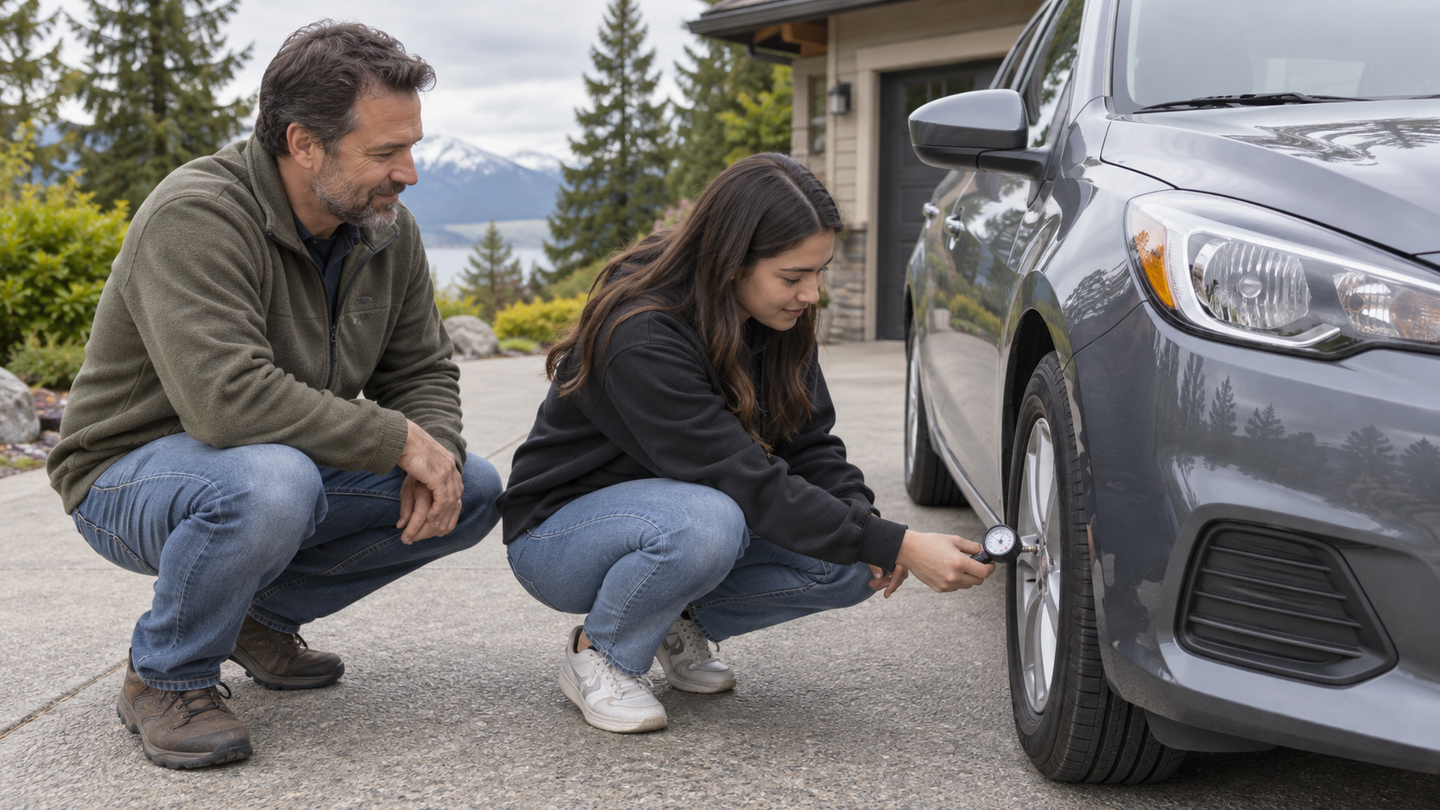
BC learners can build a tire-check habit by inspecting condition, measuring cold pressure against the vehicle instructions and resolving damage before practice.
Use the vehicle's pressure recommendation
ICBC recommends checking inflation while tires are cold and finding the correct level in the owner's manual or on the driver's door sticker. Do not use the number on the side of an ordinary road tire as your car's inflation target. With your supervisor, locate the recommendation and compare each gauge reading with it. Do not copy a pressure remembered from a different car.
Look at condition as well as pressure
Walk around the parked car in a safe place. Look for worn tread, cuts, cracks, bulges or exposed belts. ICBC identifies these forms of damage as reasons to replace a tire. A pressure reading does not clear visible damage, and a tire that looks normal still needs a gauge check. If you are unsure what you are seeing, ask your supervisor and a tire professional before practising.
Scenario: one tire reads low before the lesson
You have time for a short practice drive, but one cold tire reads below the vehicle's recommendation. Pause the departure. Have your supervisor help follow the vehicle instructions for correcting the pressure and checking the result. If pressure drops again, or damage is visible, arrange professional assessment rather than repeating top-ups and carrying on. Use the waiting time to locate the manual and practise reading the gauge; the lesson can start later.
Build a habit and remember the exam principle
Keep a gauge available and include tire condition in your pre-trip walkaround. Learn the pressure-check procedure with your supervisor before a busy day. For knowledge-test preparation, distinguish observation from measurement: looking can reveal damage; a gauge measures inflation. Neither replaces the other. In an original practice scenario asking whether to leave with an unresolved tire problem, explain why checking and correcting the problem comes before keeping the appointment.
Quick answers
Can I use the pressure printed on the tire's sidewall?
For ordinary road tires, use the vehicle owner's manual or driver-door sticker as ICBC directs. Do not substitute the sidewall number for the vehicle's recommended inflation level.
If the gauge reading is correct, can I ignore a bulge?
No. Correct pressure does not repair tire damage. A visible bulge needs attention before the practice drive; have the tire assessed and replaced as appropriate.