
How should a BC learner drive near a horse and rider?
A practical BC Class 7 guide to slowing early, leaving a wide berth, reducing noise, waiting when a horse is unsettled, and passing gently.
Updated:
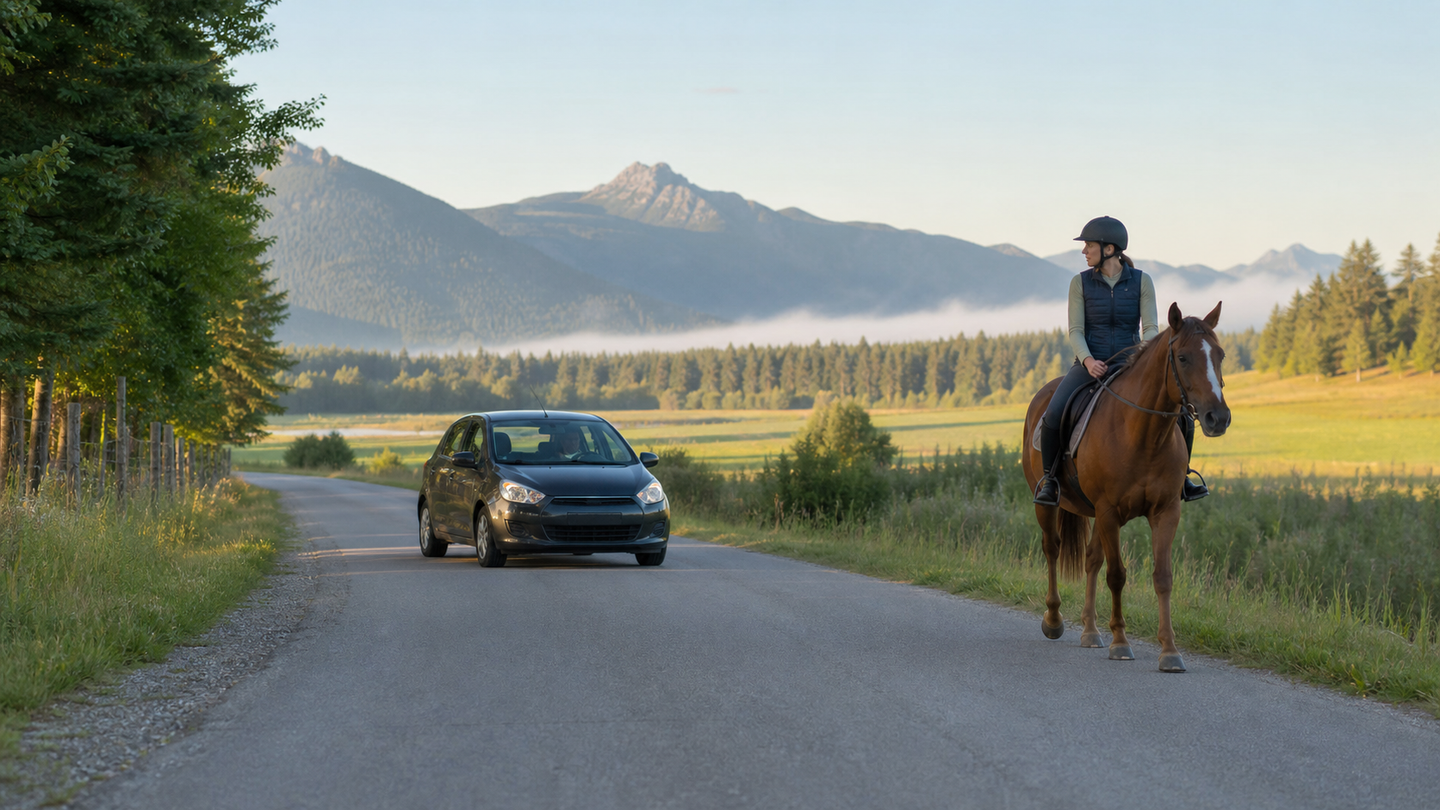
In British Columbia, a Class 7 learner approaching a horse and rider should slow early, avoid sudden noise, leave generous space, wait if the horse appears unsettled, and accelerate gently only after passing.
Recognize the hazard early and slow well back
A horse can react to a fast approach, engine noise, a horn, or loose gravel. Lift off the accelerator early, check your mirrors, and reduce speed smoothly while you still have plenty of space. Do not rush up behind the rider and then brake hard. A calm approach gives the rider time to notice you and the horse time to remain settled.
Wait until a slow, wide pass is clearly available
Stay back when the road is narrow, visibility is limited, or oncoming traffic prevents a wide berth. Pass only when you can leave generous side space without forcing another road user to change course. The BC Government describes about one car width as a typical berth. Treat that as practical space guidance, not permission to pass when the whole scene is unsafe.
Keep the car quiet and smooth beside the horse
Turn down loud audio, do not honk or rev the engine, and use gentle steering, braking, and acceleration. If the horse looks agitated or the rider signals you to wait, remain back and let the rider regain control. Once you are fully past with safe clearance, increase speed gradually rather than accelerating sharply beside the animal.
Apply the space-first answer in an exam scenario
Imagine a horse and rider ahead near the edge of a winding rural road. An oncoming vehicle blocks a wide pass and the horse turns its head toward you. The safest choice is to slow and wait well back, then pass quietly only after the oncoming lane is clear and the rider is ready. On an ICBC knowledge question, choose patience, visibility, and space over squeezing through.
Quick answers
Should I honk so the rider knows I am behind them?
No. A horn can startle a horse. Slow early and remain visible without crowding. Let the rider manage the horse, and wait for a clearly safe passing opportunity.
What if the horse becomes restless as I approach?
Stay back or stop in a safe position and avoid sudden sound or movement. Give the rider time to settle the horse, and proceed only when there is enough space and the situation is calm.