
Parking Lot Backing and Scanning for BC Class 7 Learners
A practical ICBC-aligned guide to backing, shoulder checks, mirrors, pedestrians, cyclists, and low-speed decisions in BC parking lots.
Updated:
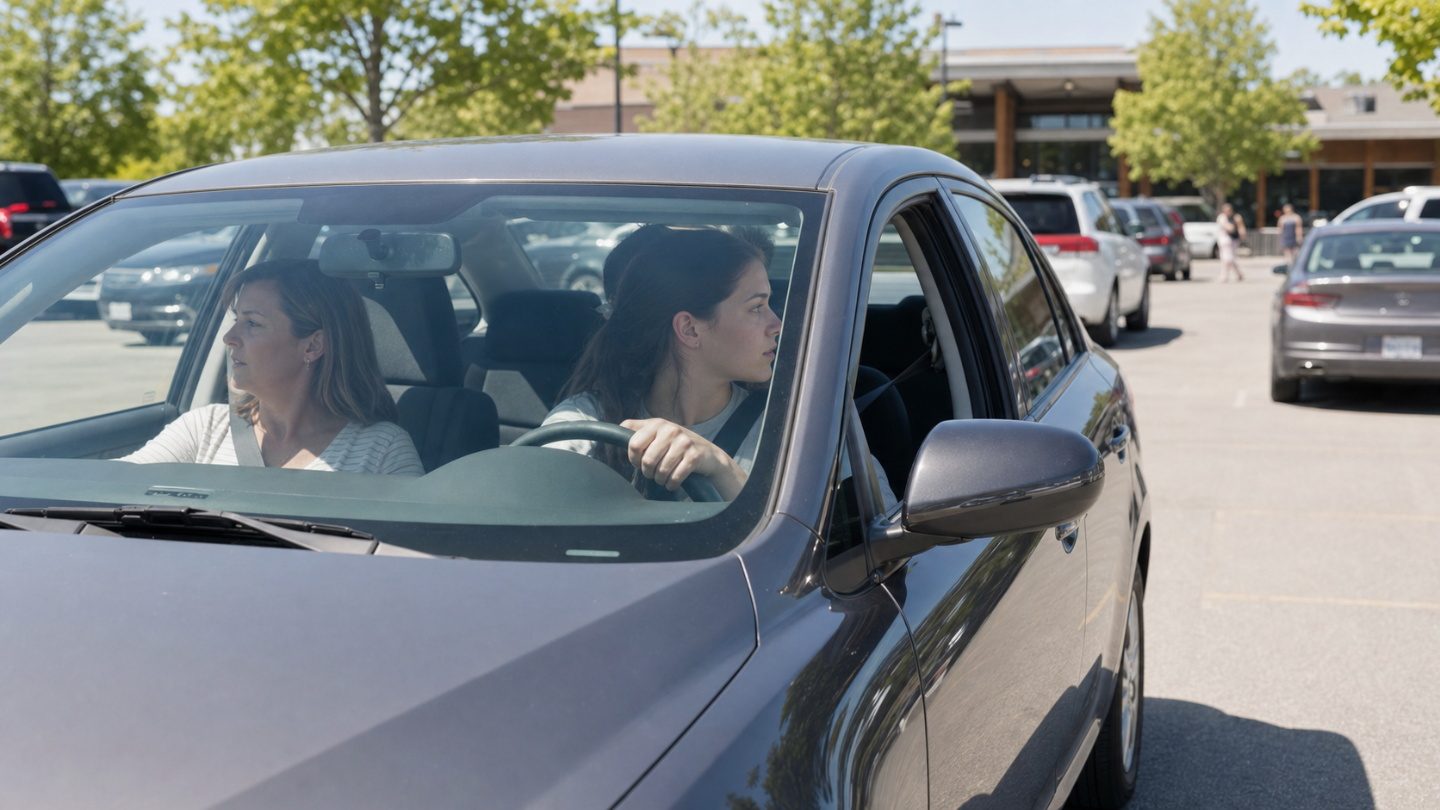
For learner drivers in British Columbia, this guide explains how to scan before backing, moving through, or leaving parking spaces in ICBC-style scenarios.
The short answer
In a BC parking lot, move slowly, communicate early, and scan more than once before you back up. ICBC emphasizes paying extra attention for pedestrians, cyclists, and other vehicles, and it warns learners not to depend only on a backup camera. For a Class 7 learner, the practical rule is simple: mirrors help, cameras help, but your eyes and shoulder checks still decide whether the space is clear.
A safe backing routine
Before reversing, pause with your foot on the brake and build a full picture of the space behind and beside the vehicle. Check the centre mirror, side mirrors, rear corners, and the area a pedestrian could enter while you are moving. Reverse at walking speed, stop if your view is blocked, and rescan if another car, shopper, cyclist, or cart changes the scene. When it is practical and allowed, backing into a stall can make your later exit easier to see.
Knowledge-test takeaways
The ICBC knowledge-test lesson is not only about parking technique. It is about hazard perception at low speed. Expect people to appear between parked vehicles, expect drivers to reverse without warning, and do not let a waiting vehicle pressure you into rushing. If the question describes a camera view, a mirror view, or a person walking behind the vehicle, choose the answer that slows the vehicle and confirms the blind spots before continuing.
Quick answers
Is a backup camera enough when reversing in a BC parking lot?
No. A backup camera can help, but ICBC guidance still expects drivers to use mirrors and shoulder checks. Cameras can miss side movement, close pedestrians, cyclists, or a changing gap.
Should a learner always back into a parking stall?
Not always. Backing in can improve your view when leaving, but only do it when the space, traffic, and your control make it safe. The safer choice is the one that keeps the vehicle slow and visible.