
How should a BC learner handle glare and limited visibility at night?
A practical Class 7 night-driving guide to controlling speed, keeping your eyes moving, managing headlight glare, and preserving enough space to stop within what you can see.
Updated:
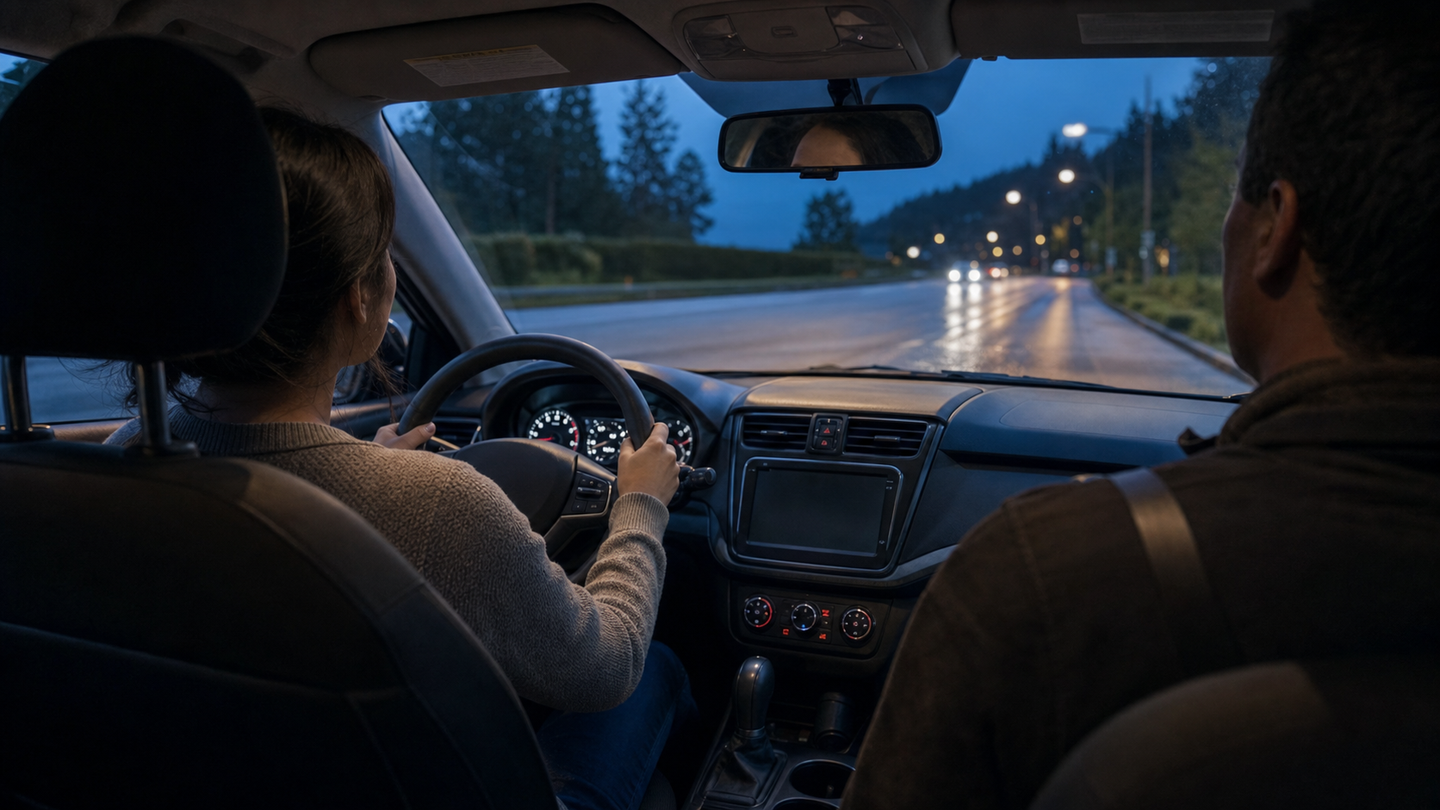
For a Class 7 learner in British Columbia, safe night driving means choosing a speed that fits the visible road, moving the eyes continuously, looking toward the right edge rather than into oncoming glare, keeping windows and lights clean, and increasing the space ahead.
Drive for the road you can actually see
Darkness shortens the distance in which you can identify a pedestrian, cyclist, animal, curve, or stopped vehicle. Choose a speed that gives you time to respond inside that visible area, even when the posted limit is higher. Keep extra space behind the vehicle ahead so its lights and your own headlight reflections do not dominate your view.
Manage glare without losing your path
Do not stare into bright approaching headlights. Ease off the accelerator, keep the vehicle steady, and glance toward the right edge of your lane as a useful path reference while continuing to scan. Set the rear-view mirror to its night position when available, keep interior lighting low, and clean the windshield inside and out because haze can scatter light.
Scenario and exam takeaway
Imagine an oncoming vehicle appears over a rise with very bright lights while the road ahead bends gently. Avoid looking at the lights or making a sudden steering correction. Reduce speed smoothly, hold a predictable path using the right side of your lane as a reference, and rebuild your full scan after the vehicle passes. On the knowledge test, favour the answer that reduces speed and preserves visibility and space, not one that adds glare or rushes through the dark area.
Quick answers
Where should I look when oncoming headlights cause glare?
Avoid staring at the headlights. Slow smoothly and use the right edge of your lane as a temporary path reference while keeping your eyes moving for hazards. Return to a full forward scan as soon as the vehicle passes.
Why should I leave more following space at night?
More space gives you additional time to identify a hazard and respond when your sight distance is shorter. It also reduces the amount of glare and reflected light from the vehicle ahead.