
How BC Class 7 Learners Should Scan for Motorcycles at Intersections
A source-aware BC learner guide to seeing motorcycles, judging gaps, checking blind spots, and answering ICBC knowledge-test scenarios.
Updated:
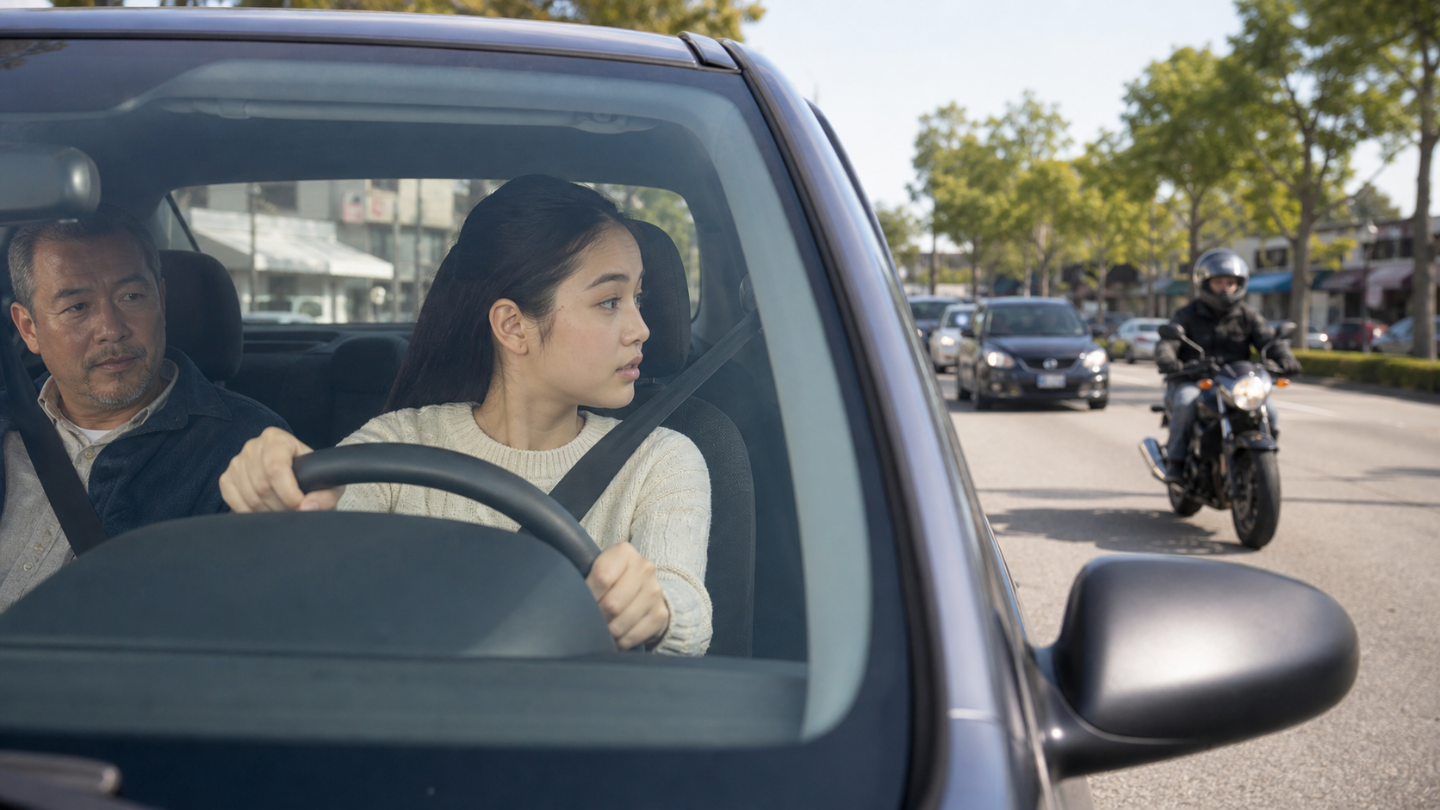
For British Columbia learner drivers, this guide explains how to look for motorcycles in intersection, turn, and shared-road scenarios common to ICBC study.
The short answer
When a BC learner-driver question involves a motorcycle near an intersection, do not treat it like just another car shape. ICBC notes that motorcycles are smaller than passenger vehicles, which can make them harder to see and harder to judge for speed or distance. The safe learner habit is to scan once, pause, scan again, and only turn or cross when the gap is clearly safe.
Where to look before you turn
Build a routine before left turns, right turns, and lane changes near intersections. Check far ahead, the oncoming lane, the side streets, mirrors, and the shoulder area beside your vehicle. Look for a headlight, a narrow vehicle profile, or a rider hidden beside a larger vehicle. If a bus, truck, parked vehicle, or bright sun blocks your view, assume your information is incomplete and wait until you can see more.
Knowledge-test takeaways
ICBC motorcycle guidance points learners toward extra intersection scanning, distraction control, and generous space. On the knowledge test, answers that rush into a turn, assume the rider has seen you, or rely on a quick glance are weak choices. Strong answers slow down, look again, keep a following gap, and avoid moving until the motorcycle's position and path are clear.
Quick answers
Why do BC learner questions focus on motorcycles at intersections?
Intersections combine turning decisions, gap judgment, and blind spots. Motorcycles are smaller, so a learner may miss them or misjudge how quickly they are arriving.
What should I do if I am not sure whether the gap is safe?
Wait. In an ICBC-style scenario, uncertainty means you do not yet have enough information. Take another scan, keep the vehicle controlled, and move only when the path is clearly safe.