What should a BC learner do when another driver tailgates?
A practical BC Class 7 guide to staying calm, protecting space ahead, avoiding retaliation, and letting a tailgater pass only when it is safe.
Updated:
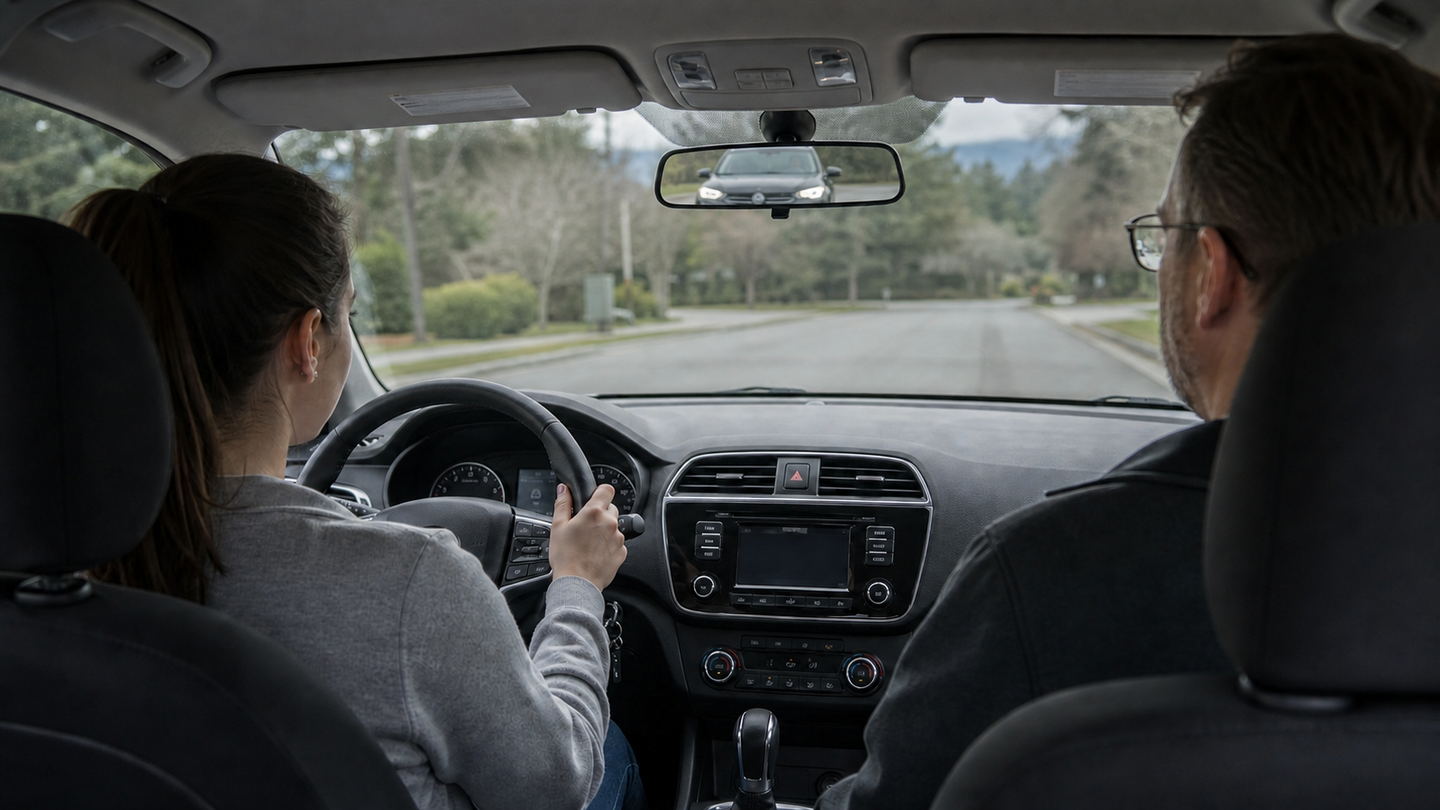
In British Columbia, a Class 7 learner should respond to a tailgater by staying predictable, increasing the space ahead, and allowing the other vehicle to pass when a safe lane change or pullout becomes available.
Stay predictable instead of reacting to pressure
Keep your eyes moving, hold a steady course, and drive at an appropriate speed for the road and conditions. Do not race away, brake-check, gesture, or stare in the mirror. Those reactions reduce your attention and can turn one unsafe driver into a conflict involving two vehicles.
Build more space in front of your car
You cannot control the gap behind you, but you can protect the space ahead. Ease off slightly and smoothly if needed so the following distance in front grows. If traffic ahead slows, that extra room lets you brake gradually and gives the tailgater more time to respond. Avoid sudden speed changes.
Let the driver pass at a genuinely safe place
On a multi-lane road, move to another suitable lane after a full mirror, signal, and shoulder-check routine when the gap is safe. On a two-lane road, use a legal pullout or safe roadside stopping place if one appears. Do not stop on a blind curve, narrow shoulder, intersection, or anywhere that creates a new hazard.
Use the calm-choice test in a driving scenario
Imagine a car closes the gap behind you on a wet suburban road while another vehicle is ahead. The best choice is to keep control, enlarge your forward gap, and wait for a safe way to let the impatient driver go by. For an ICBC knowledge-test question, prefer the answer that creates time and space without speeding, confrontation, or abrupt braking.
Quick answers
Should I speed up when someone is following too closely?
No. Speeding can reduce your control and may encourage the other driver to keep pressuring you. Maintain an appropriate speed, create more room ahead, and let the vehicle pass when you can do so safely.
Is tapping the brakes a safe way to warn a tailgater?
Do not brake-check or make a sudden braking move. If you need to slow, do it early and smoothly. Your priority is predictable vehicle control and enough space ahead to avoid an emergency stop.